Tuesday, 3 March 2009

Richard Wentworth

Hi all...again!


I have found an artist who I thought creates the sort of photographs that I'm wanting to base my Outside the White Cube on; objects that belong to someone or belong inside that have been placed outside in an "un-natural" environment...basically objects that you wouldn't really see in this type of scenario; giving these objects a different meaning.

This artist is Richard Wentworth, and he describes his work better than I can, so here is a quote of his which I think best explains his photographs:

'I have always been very puzzled about the raw and the cooked. Am I sitting on a tree or is this assemblage of wood a chair? What draws me in is how things are convertible and how humans give meaning. There is something about mutability that I have always been attracted to. I mean, what is a television that is sitting on the roadside miles away from the electricity supply? Is it still a television? It's something to do with being dead yet alive. It's the small human acts that reach out to my way of seeing. Without someone being able to raise a brick and deposit the right amount of mortar then there would be no walls. That's all a wall is really - a lot of brick raising. A little human act multiplied. A half brick raised, though, can be a murder weapon.

My work is also attached to the limits of purposefulness. If something is discarded you can read that and see that it's been rejected. To me, there is something terribly beautiful in that. Formal things are incredibly important to me. I always see the crack in the glass before I see the window. I have always had this "sickness". I am interested in the aberrant.'

Wentworth


Katie =)

Dare I mention Banksy once again???

Hi all,


Since we were talking about surveillance today, I thought this work of Banksy's was appropriate for this topic...enjoy =D!


Katie =P

Monday, 2 March 2009

VICTOR PASSMORE "APOLLO PAVILLION"
This urban creation was comissioned by Peterlee County Councill,the artist Victor Passmore ,wanted to build a walk in walk out ,a place to linger to think dream,play as he said "a free anonymous monument".
this was the idea .
However by the 1970s "sunny blunts"became certainley a place to loiter.it became a drug den,litter strewn everywhere,a no go area ,and being next to a lake it became covered in mould a real sodding eyesore.I love this building its been panned by locals and critics,they are now coming round to the idea and spending money on it!

blind man eating winkles

OPENING THE DOOR WITH A PIN
HE GRUBS FOR PURCHASE,
TUGGING FREE
THE FIRM TWIST OF MEAT
CHEWING IT
AS HE ROOTS OUT THE NEXT .

SPECKLED WITH THE RUST/BROWN
CIRCLES,TRANSLUCENT AS SCABS,
HE COULD SIT HERE FOREVER;
THE RUSTLE OF THE PAPER BAG,
THE SHELLS SCRAPING,THE RUMMAGE
THE SHUCK OF THE WAVES

POEM FROM A PANTED FIELD BY ROBIN ROBERTSON

Sunday, 1 March 2009

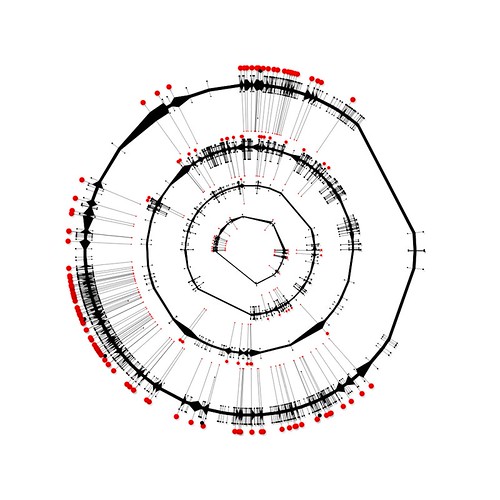
Oli Laruelle - Invisible Journeys


"Invisible Journeys is my first try at data visualisation. I have seen a few wifi geographical mapping, but they looked a bit too technical to my taste. Here, i aimed at a semi abstract visualisation while keeping the ability to extract sense out of the graphics. Below is one of the visualisation showing 4 different journeys. Bigger to smaller rings : London / Vescemont / Belfort / Barcelona.
Each circular item represent the recording of wireless networks along one journey.
The time dimension starts reading from the right then goes clockwise along the main black thick line.
Each successful node recording influences the time line thickness and adds a “pin” onto it. Red pins represents non encrypted networks other networks are the smaller black ones.
More images of the ongoing process can be found on my flickr set"


The Mostar Bridge
The Mostar Bridge was a very famous and historical bridge before its destruction in 1993 during the war in Bosnia and Hercegovina. The elegant bridge spanned the River Neretva and was designed by the Ottoman (Turkish) architect Mimar Hayruddin. It was completed in 1566 after nines years of building and the surrounding town became a thriving trading centre. The bridge was 29 metres in length and stood at a height of 20 metres, a classic example of a single span, stone arch bridge and was an example of advanced technology in its time. It became a World Heritage site during the twentieth century.
In response to Roddy, i find it interesting how these bridges have a similar shape, whether it be for design or practical reasons. Possibly it was easier to construct like this, or maybe it was just for aesthetical purposes. I am also interested in what you said about reconstruction and substitution. The mostar bridge was rebuilt using some of the limestone salvaged from the riverbed below from the previous destroyed bridge.
The rebuilding of the bridge symbolises the reunification of Mostar and will be part of the healing process for this ethnically divided town. I think i will begin to look closely at York's bridges and the history behind them!


Ouse Bridge (1821)

The original Roman bridge over the Ouse was eventually replaced by a wooden bridge built further downstream by the Vikings. In 1154, it collapsed under the weight of a crowd which had gathered to greet St William of York on his return from exile. It was replaced by a stone bridge, but part of this was swept away by floods in the winter of 1564-5. The repaired bridge of 1565 had a new central arch spanning 81ft, and was described by Defoe as "...near 70 foot [21 m] in diameter; it is, without exception, the greatest in England, some say it's as large as the Rialto at Venice," This bridge was dismantled between 1810 and 1818 in order to make way for the New Ouse Bridge, designed by Peter Atkinson the younger, completed in 1821.


An engraving of the Tudor-built bridge